

Welcome to Groovy Eats, where we’re cooking our way through the decades, one groove at a time. In Season One, we’re stepping back into the 1970s—a decade of bold flavors, unforgettable music, and iconic cultural moments that still influence us today.

👉 Listen to this episode of The Artful Gourmet Podcast on Spotify — Deep dives into food, culture, memory, and the stories behind the recipes. Perfect for your commute, your kitchen, or your next late night.
If there was ever a moment to turn up the music, shake up a retro cocktail, and bring a little sparkle to the table, this is it. For this latest Groovy Eats episode, I’m taking inspiration from Donna Summer, her iconic hit “Last Dance,” and the glamorous, glittery world of 1978 disco culture to create a classic dinner reimagined.
The inspiration behind this episode
This episode is part food story, part music memory, part time machine. And honestly, that’s my favorite kind of recipe inspiration.
From the flashing lights of the disco floor to the late-night bite energy of Los Angeles nightlife, this menu brings together everything I love about creating food with a little extra mood. Think Midori Sour cocktails, Crab Rangoon with plum sauce, and a whole lot of retro fun.

This month, we’re heading to late Spring 1978, when disco ruled the airwaves,

Donna Summer reigned supreme, and the nightlife scene in Los Angeles was every bit as glamorous as the movies made it look.
The idea for this episode came from the magic of Donna Summer’s “Last Dance” and the 1978 film Thank God It’s Friday. Donna Summer was one of the defining voices of the disco era, and her music helped shape the sound, style, and energy of late-1970s nightlife. Her voice had that rare mix of power, glamour, emotion, and pure dance-floor joy.
“God had to create disco music so that I could be born and be successful.” — Donna Summer
“Last Dance” is one of those songs that instantly transports you. It has that big, emotional, everything-is-happening-right-now feeling that makes disco feel like more than music — it feels like a whole world. That’s exactly the mood I wanted to capture with this episode.
Watch / Listen to Donna Summer perform “Last Dance,” the song that helped define the spirit of this episode.
Thank God It’s Friday and the disco scene in Los Angeles
Thank God It’s Friday was released in 1978 and captured the height of disco-era nightlife with all the glitz, energy, and after-hours glamour you’d expect. One of the things I love most about this film is the atmosphere — it wasn’t just about music, it was about the entire night-out experience.
The disco scenes were filmed at Osko’s, a real disco club on Restaurant Row in Los Angeles, which makes the whole setting feel even more rooted in the nightlife culture of the time. That stretch of restaurants and late-night spots became part of the after-disco ritual: dance all night, then head out for cocktails, snacks, and a little more conversation before heading home.
That is such a fun culinary idea to play with, because suddenly the food becomes part of the story. It’s not just dinner — it’s what you eat after the music has already started to fade, but the mood is still glowing.
By the spring of 1978, disco had become more than a music genre. It was a lifestyle.


People dressed for it.

Danced to it.

Decorated their homes around it.

And gathered together in clubs and restaurants built around the energy of the era.
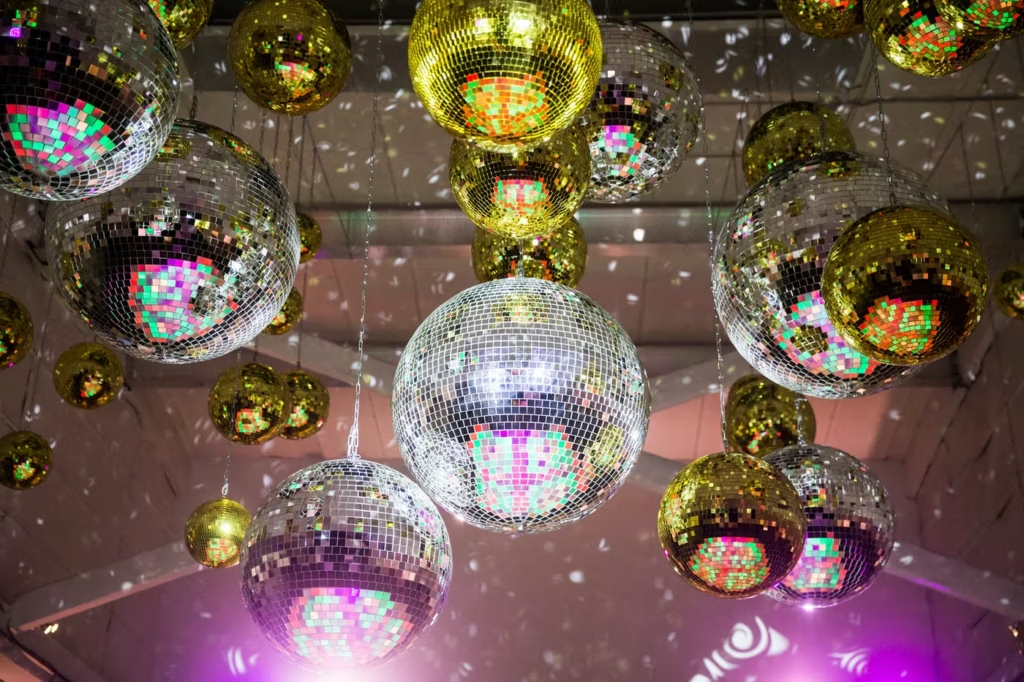
Then Hollywood bottled that feeling and released it onto the big screen.

Thank God It’s Friday debuted in May 1978 and followed a cast of colorful characters through one unforgettable night at a Los Angeles disco

inspired by the legendary nightlife scene surrounding Restaurant Row

and Osko’s disco club, where the movie was filmed in 1978.

Watch a clip of Donna Summer singing ‘Last Dance’ from the movie:
The Islander and the late-night bite vibe
As I was dreaming up the menu, I kept thinking about The Islander, the tiki-style spot that was a popular hangout in 1978 and helped inspire the playful, after-hours feel of this episode. The Islander had that unmistakable late-night, tropical, a little-bit-glam, a little-bit-unserious energy that fits disco so beautifully.


That became the seed for the recipes in this episode — especially the Midori Sour and Crab Rangoon with plum sauce. I wanted cocktails and appetizers that felt like they belonged on a late-night menu after a full evening of dancing, laughing, and lingering over one more drink.

The result is a menu that feels equal parts disco, tiki bar, and retro dinner party.
Donna Summer’s impact on disco
Donna Summer’s influence on disco cannot be overstated. She was one of the genre’s most important voices, and her music helped take disco from club culture into mainstream pop culture. Songs like “Last Dance,” “I Feel Love,” “MacArthur Park,” “Hot Stuff,” and “Bad Girls” became defining records of the era.

What made Donna Summer so special was not just her voice — though that alone was unforgettable — but the way her music carried both sophistication and soul. She could be glamorous, playful, emotional, and ecstatic all in the same song. That combination helped shape the sound of late-70s disco and made her an enduring icon far beyond the genre itself.
Disco was never just about glitter. It was about freedom, expression, community, movement, and joy. Donna Summer’s music captured all of that, and that’s part of why she remains so deeply connected to the era.

Her 1977 masterpiece, “I Feel Love,” didn’t just play in clubs — it detonated them. That pulsing, hypnotic, entirely synthesized rhythm was unlike anything the world had ever heard. Even David Bowie, one of the most prescient artists of the century, stopped cold when he heard it. As his long-time collaborator Brian Eno famously recounted, Bowie burst into the recording studio and declared:
“I have heard the sound of the future.”
Giorgio Moroder himself understood the magnitude of what he and Donna had created. The German-Italian producer, who would go on to become one of the most decorated in music history, described their creative partnership as something almost telepathic — a collision of her emotional depth and his technological fearlessness. Together, they didn’t just make records. They built worlds.
But if “I Feel Love” was the revolution, then “Last Dance” was the rapture.

The menu: what I made for the episode
For this episode, I wanted the food to feel like something you’d order after a long night out — colorful, fun, and just a little indulgent.

Midori Sour
The Midori Sour is a perfect disco-era cocktail because it feels playful, vibrant, and unmistakably 1978. Midori first launched in that era, and the bright green color is pure retro nightlife energy. It’s the kind of drink that looks incredible on camera and tastes like a little time capsule in a glass.

Midori — the Japanese honeydew melon liqueur — was introduced to the American market in 1978 at a legendary launch party held at the one and only Studio 54 in New York City.

The party was thrown in honor of the film Saturday Night Fever, and the guest list included the who’s who of the disco era. From that moment forward, Midori became the drink of the moment — sweet, citrusy, just a little bit wild, and perfectly at home in a room full of sequins and spectacular music.

A Midori Sour is the cocktail equivalent of “Last Dance.”
It starts fun and light, and then it hits you — warm and bright and a little euphoric. Mix one up, turn the music on, and I promise you’ll understand exactly what I mean.

🥂 Midori Sour — The Islander Style
Makes 1 cocktail | Easily multiplied for a crowd
Ingredients
-
- 1½ oz Midori melon liqueur
- 1 oz premium vodka (something smooth — Tito’s or Grey Goose work beautifully)
- 1 oz fresh lemon juice (always fresh — this is non-negotiable)
- ¾ oz fresh lime juice
- ½ oz simple syrup (adjust to taste — see note below)
- Ice
- For garnish: Maraschino cherry + thin lemon wheel or a sprig of fresh mint
For the Simple Syrup (make ahead)
-
- ½ cup granulated sugar
- ½ cup water
- Combine in a small saucepan over medium heat, stirring until sugar dissolves completely. Cool fully before using. Keeps refrigerated for up to 2 weeks.
Method
-
- Fill a cocktail shaker with ice — generously. You want this very cold.
- Add the Midori, vodka, lemon juice, lime juice, and simple syrup.
- Shake vigorously for a full 15 seconds. Don’t be shy — you want it properly cold and slightly frothy.
- Strain into a chilled rocks glass filled with fresh ice, or serve up in a coupe for maximum drama.
- Garnish with a maraschino cherry and lemon wheel. If you want to go full Islander tiki bar, add a paper cocktail umbrella and don’t look back.
Artful Gourmet Notes:
-
- For a party punch version, multiply by 8 and mix in a large pitcher. Omit the ice and serve over a large ice block in a punch bowl for a showstopping presentation.
- If you prefer a sweeter cocktail, increase the simple syrup by ¼ oz. If you like it more tart (my preference), reduce to ¼ oz and let the citrus shine.
- Non-alcoholic version: Substitute the vodka with sparkling water and the Midori with a honeydew melon juice blend + a splash of green apple juice. Just as festive.

🍤 The Bite: Crab Rangoon with Homemade Plum Dipping Sauce
If the Midori Sour is the star of the drink menu, then Crab Rangoon is the undisputed queen of the late-night snack table. And like all the best things from this era — it is slightly over the top, completely irresistible, and utterly impossible to eat just one of.

Crab Rangoon with plum sauce is exactly the kind of crispy, creamy appetizer that belongs on a late-night menu. It’s nostalgic, crowd-pleasing, and perfect for a disco-inspired spread. The plum sauce gives it a sweet and tangy finish that makes every bite feel a little more polished.
Crab Rangoon is, in the most wonderful way, a distinctly American invention dressed up in an Asian-inspired costume. It became a staple of Polynesian-American restaurants like The Islander in the 1970s — part of that dreamy tiki bar tradition where the food was more about indulgence and escapism than culinary authenticity. And honestly, decades later, I have zero complaints.


Golden-fried wonton wrappers. A filling that’s creamy and rich, with just the right amount of savory sweetness from the crab. And then that plum dipping sauce — dark, complex, tangy, with a hint of warmth from fresh ginger — that transforms the whole thing into something you genuinely cannot stop eating.

This recipe is elevated just enough to feel special, but still wildly easy and deeply satisfying. The kind of food that’s meant to be passed around a table, eaten with your fingers, and shared with people you love.

🥟 Crab Rangoon with Homemade Plum Dipping Sauce
Makes approximately 24 pieces | Serves 6–8 as an appetizer
FOR THE CRAB RANGOON
Ingredients
- 1 package (about 48) square wonton wrappers
- 8 oz full-fat cream cheese, at room temperature (room temp is key — it blends smoothly)
- 8 oz lump crab meat, drained and picked over for shells (fresh or good-quality canned; imitation crab works in a pinch but fresh is incomparable)
- 3 green onions (scallions), finely sliced — white and light green parts
- 2 cloves garlic, finely minced or pressed
- 1 tsp soy sauce (or tamari for gluten-free)
- 1 tsp Worcestershire sauce
- 1 tsp toasted sesame oil
- ½ tsp fresh ginger, finely grated
- Pinch of white pepper
- Small bowl of water (for sealing)
- Neutral oil for frying (vegetable, canola, or avocado oil) — about 3–4 cups
Method
Make the filling:
In a medium bowl, beat the cream cheese until smooth and fluffy. Add the crab meat, green onions, garlic, soy sauce, Worcestershire, sesame oil, ginger, and white pepper. Mix gently until just combined — you want the crab to have some texture, not become a paste. Taste and adjust seasoning. Cover and refrigerate for at least 20 minutes (this helps the filling firm up and makes it much easier to work with).
Assemble the rangoon:
Lay a wonton wrapper on a clean, dry surface with one corner pointing toward you like a diamond. Place a heaping teaspoon of filling in the center — don’t be tempted to overfill or they’ll burst while frying. Dip your finger in water and trace all four edges of the wrapper. Fold the wrapper in half to form a triangle, pressing firmly to seal and pushing out any air pockets. Then bring the two bottom corners up and press them together to form the classic “crown” shape. Press firmly to seal. Place on a parchment-lined baking sheet while you repeat with the remaining wrappers.
Note: If you want to simplify the fold, a simple triangle seal works beautifully too.
Fry the rangoon:
Pour oil into a heavy-bottomed pot or Dutch oven to a depth of about 3 inches. Heat over medium-high heat until it reaches 350°F on a thermometer. (No thermometer? Drop a small piece of wonton wrapper in — it should sizzle and float immediately.)
Working in batches of 4–6 (don’t crowd the pot — this is the single most important rule of frying), carefully lower the rangoon into the oil. Fry for 2 to 2½ minutes, turning once halfway through, until deeply golden and perfectly crisp. Remove with a slotted spoon and drain on a paper towel-lined plate. Season immediately with a tiny pinch of flaky sea salt while still hot.
Serve immediately — they are at their absolute best right out of the oil.
Make-ahead tip: Assemble the rangoon in advance and freeze them flat on a baking sheet, then transfer to a zip-lock bag. Fry directly from frozen, adding 1–2 minutes to the cooking time. Perfect for a party.
FOR THE HOMEMADE PLUM DIPPING SAUCE
This is the sauce that makes everything better. It comes together in about 15 minutes and it’s so far superior to anything from a jar that I promise you’ll never go back.
Ingredients
- 1 cup ripe red or black plums, pitted and roughly chopped (about 3 medium plums; frozen plums work well when fresh aren’t in season)
- 3 tbsp rice wine vinegar
- 3 tbsp granulated sugar
- 2 tbsp soy sauce
- 1 tbsp hoisin sauce
- 1 tsp fresh ginger, grated
- 1 clove garlic, minced
- ¼ tsp Chinese five-spice powder
- ¼ tsp red pepper flakes (optional — for a gentle heat)
- 2 tbsp water
Method
Combine all ingredients in a small saucepan over medium heat. Stir to combine and bring to a gentle simmer. Cook, stirring occasionally, for 10–12 minutes, until the plums have completely broken down and the sauce has thickened slightly.
Carefully transfer to a blender (or use an immersion blender directly in the pot) and blend until smooth. Taste and adjust — more vinegar for tang, more sugar for sweetness, more soy for depth.
Pour into a serving bowl and let cool slightly before serving alongside the warm rangoon. The sauce will thicken further as it cools.
Keeps refrigerated in an airtight jar for up to 2 weeks. Also spectacular on grilled salmon, roasted duck, and pork dumplings.
“Disco was about more than the dance floor — it was a feeling.”
🎵 The Playlist: Donna Summer’s Disco Decades
Because every great meal deserves a great soundtrack — and this one is non-negotiable.
👉 **[Listen on Spotify: Groovy Eats Episode 4 — Donna Summer & the Disco Era, 1978]**A 20-song deep dive featuring Donna Summer’s greatest disco hits alongside the biggest tracks of 1978 — from Chic to Bee Gees, Gloria Gaynor to Sister Sledge.
The Donna Summer Essentials:
- Last Dance
- I Feel Love
- Love to Love You Baby
- Hot Stuff
- Bad Girls
- MacArthur Park
- On the Radio
- Heaven Knows
- Dim All the Lights
- Could It Be Magic
- I Love You
- Rumour Has It
- Our Love
- Spring Affair
- Try Me, I Know We Can Make It
- The Wanderer
- She Works Hard for the Money
- No More Tears (Enough Is Enough) (with Barbra Streisand)
- Love’s Unkind
- I Remember Yesterday
+ The Best of 1978:
Le Freak — Chic | Stayin’ Alive — Bee Gees | I Will Survive — Gloria Gaynor | We Are Family — Sister Sledge | Got to Be Real — Cheryl Lynn | Dance, Dance, Dance — Chic | Shame — Evelyn “Champagne” King | Boogie Oogie Oogie — A Taste of Honey
Watch the full Groovy Eats episode
This recipe story is part of my Groovy Eats series on YouTube, where I love bringing food, music, memory, and style together in one place. The full cooking video is coming soon, and I can’t wait to share the disco-night menu in motion.
Stay tuned for the full Groovy Eats video coming soon!
Listen to the companion podcast
Listen to Episode 4: Disco Night Bites 1978 Donna Summer, Last Dance on The Artful Gourmet Podcast.
✨ The Feeling Is the Recipe
I love recipes that tell a story, and this one is full of them. From Donna Summer’s unforgettable voice to the shimmering energy of Thank God It’s Friday, from Osko’s on Restaurant Row to the playful late-night spirit of The Islander, this episode is a celebration of a very specific, very fabulous moment in time.
And honestly? That’s what makes food fun.
What I love most about revisiting this era — about cooking through it, listening through it, sitting with it — is the reminder that none of it existed in isolation.
The music wasn’t separate from the moment. The food wasn’t separate from the experience. The cocktail wasn’t separate from the connection. It all lived together, layered and inseparable — the sound and the taste and the light and the company. All of it conspiring to create something that felt, for a few hours, like the most alive you’d ever been.
And maybe that’s really what we’re doing when we pull out a recipe from 1978 and make it on a Tuesday night in our own kitchen. We’re not just recreating a dish. We’re reaching for a feeling. A temperature. A particular quality of light that we remember, or that we never had but somehow recognize.
Donna Summer understood this better than almost anyone. She didn’t just make music for dancing. She made music for living — for the kind of nights you replay for decades. Nights where everything felt connected and nothing felt ordinary and the last song of the evening always, always, arrived too soon.
So turn it up. Make the rangoon. Shake the cocktail. Dance in your kitchen.
Because the night isn’t over yet.
🌟 About Donna Summer: A Legacy
LaDonna Adrian Gaines (December 31, 1948 – May 17, 2012) was an American singer, songwriter, and actress who became the best-selling musical artist of the disco era. She was the first artist to have three consecutive double albums reach number one on the Billboard 200, and the first to have four number-one singles in a single calendar year. She won five Grammy Awards, a Golden Globe, and an Academy Award, and was inducted into the Rock and Roll Hall of Fame in 2013.
She was, and remains, simply — the Queen of Disco.
📣 Keep the Party Going
Loved this story? Here’s how to follow along for more food, music & nostalgia:
👉 Subscribe to The Artful Gourmet on Substack — New essays, recipes, and storytelling delivered straight to your inbox. Don’t miss an episode.
👉 Watch on YouTube — The Artful Gourmet Channel — Full Groovy Eats episodes, food styling reels, behind-the-scenes content, and more.
👉 Read More on The Artful Gourmet Blog — Recipes, food styling tips, seasonal editorials, and the full archive of Groovy Eats essays.
Groovy Eats — where we cook through the decades, one groove at a time. 🪩
#DonnaSummer #LastDance #ThankGodItsFriday #DiscoDinner #GroovyEats #RetroRecipes #MidoriSour #CrabRangoon #CoconutShrimp #VintageCocktails #DiscoEra #FoodAndMusic #1970sStyle #LosAngelesHistory #TikiBarVibes